

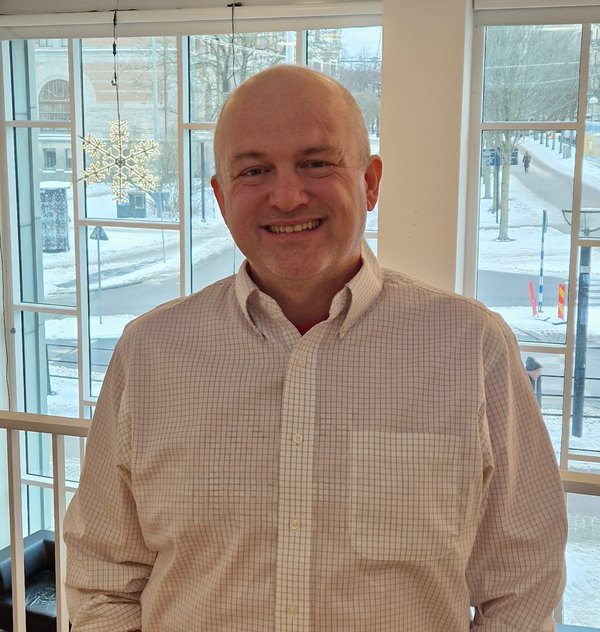
Steven Wilson started his position as Associate Professor at the Department of Political Science at the University of Gothenburg and V-Dem Institute Director on February 1, 2026.
He is however not new to V-Dem, he was a Postdoctoral Research Fellow at the institute between 2016-2017 and has served as a project manager for computational infrastructure and the Chief Technical Officer for V-Dem for many years.
We asked Steven a few questions about his new role, his priorities for V-Dem and what research interest he brings with him to the project.
What do you most look forward to in your new role?
Being able to serve as Director of the V-Dem Institute is an incredible honor, and it’s humbling to take leadership of an institution that has been so foundational in modern political science. Staffan Lindberg has left enormous shoes to fill, and I’m looking forward to being able to continue working with him and the rest of the extended worldwide V-Dem team in continuing the V-Dem mission.
What are your main priorities for V-Dem in the next years?
My first priority is to keep doing what V-Dem has been doing successfully for nearly two decades: measure the different dimensions of democracy with the highest scientific rigor. But I also envision being able to add my own touch to the Institute, building on the proven approach of expert coding by recruiting experts on new substantive topics like digital politics and cybersecurity. I’m excited for the opportunities this affords, while being incredibly grateful for the trust that has been placed with me.
What are your main research interests?
The core focus of research throughout my career has been trying to better understand how and why democracy and authoritarianism become entrenched, and how we might better encourage the development of democratic norms. I’ve taken particular interest in digital politics, fitting the rise of new communications technologies into our theoretical understandings of how political communication influences regimes.
Speaking of communication technologies and digital politics, you are also a principal investigator in the Digital Society Project (DSP). Could you tell us a bit more about the DSP and your research in the project?
The Digital Society Project aims to understand how the internet affects politics, and does so using the expert-coded approach to measurement pioneered by V-Dem. Communication is the lifeblood of politics, and so the internet’s role in putting unprecedented capacity for communication in the hands of normal people around the world has the potential to radically alter political outcomes both in positive and negative ways.
My research with my fellow DSP PIs has produced some of the first worldwide measures of the prevalence of disinformation online, in addition to a suite of measures of different dimensions of cybersecurity capacity both at the state and individual level.
---
Steven Wilson has a PhD in Political Science from the University of Wisconsin, Madison, and has since worked at the University of Nevada, Reno, and most recently as an Associate Professor of Politics at Brandeis University.
More information about the Digital Society Project.