


Academic Freedom

The Academic Freedom project aims to inform stakeholders, provide monitoring yardsticks, alter incentive structures, challenge university rankings, facilitate research, and ultimately promote academic freedom.

About

The Academic Freedom Index (AFI) project is a collaborative effort initially launched in 2019 between researchers at Friedrich-Alexander-Universität Erlangen-Nürnberg (FAU), the V-Dem Institute, the Scholars at Risk Network, and the Global Public Policy Institute (GPPi). At present, V-Dem and FAU continue to implement the project with a grant from the German Volkswagen Foundation. AFI scores rely on five separate indicators, which in turn are based on assessments by more than 2,300 country experts. They are collected and integrated by V-Dem using a Bayesian measurement model.

The AFI project aims to inform stakeholders, provide monitoring yardsticks, alter incentive structures, challenge university rankings, and facilitate research. GPPi and the Scholars at Risk Network have developed detailed policy recommendations on how AFI data can help protect academic freedom.

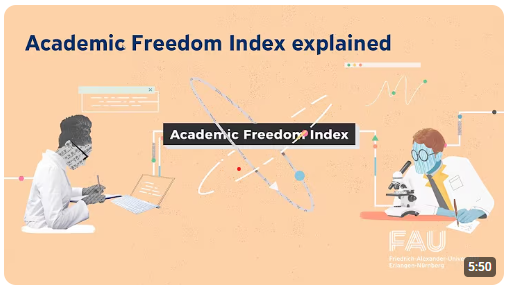
AFI video screenshot

Research and science are the key to social progress. But what happens when scientific research encounters hostility or repression? Around the world, academics and universities face interference, censorship or even violent reprisals. While many countries have committed to ensuring an open and free academic environment, in many places academic freedom is under attack.

Watch the video Academic Freedom Index Explained (link to YouTube) to learn more about the methodology behind the index and explore why academic freedom is so important.

Resources and Articles

Further information on the indicators’ conceptualisation and policy relevance.

Academic Freedom Index Update 2026

Over the last decade, academic freedom has declined in 50 countries, and only 9 countries have registered improvements.

While all dimensions of academic freedom are now declining in more countries than those in which they are improving, the most widespread declines are occurring in individual-level dimensions and campus integrity. By contrast, fewer countries are experiencing declines in institutional autonomy.

This year’s report nevertheless focuses on institutional autonomy, which is widely recognized as fundamental to protecting individual-level dimensions of academic freedom. Our data confirm that higher levels of institutional autonomy are associated with stronger protection for the freedom of individual academics.

In addition, our data show that declines in institutional autonomy are widespread among (former) democracies, and the decline in institutional autonomy in the United States stands out as a case of fast and steep deterioration that warrants comparative analysis.

Click here to access the update for 2026

Autocratization through academic capture: When and how would-be autocrats threaten academic freedom

Drawing on global data from the Episodes of Regime Transformation (ERT) and the Academic Freedom Index (AFI), the article examines the relationship between autocratization episodes and changes in academic freedom between 1990 and 2024. The quantitative analysis is compelented by four case studies – India, Georgia, Venezuela, and Poland – tracing the strategies through which governments undermine academic freedom as part of their broader autocratizing toolkit.

Overall, the article offers a novel conceptual lens for understanding the dynamics of autocratization, recognising academic capture not as a symptom of autocratization, but as a distinct pathway through which autocratization unfolds.

Click here to access the Article

Can free academia withstand democratic backsliding? Why some universities wither while others survive

Academic freedom faces threats worldwide, including in some democracies that have traditionally been viewed as bastions of free universities. Previous research shows that attacks on academic freedom are systematically linked to democratic backsliding. However, in some democracies that experience backsliding, academia remains autonomous.

Through an explorative study design, the authors of this article analyse various political and academia-related determinants of academia’s resilience during democratic backsliding. The analysis shows that an autocratization episode reduces academic freedom resilience only slightly to levels between 96.7% and 95.5% for a given country-year, compared to over 99.5% for country-years without such episodes. Overall, the analysis highlights remarkable academic resilience.

Click here to access the Article

Quality Assessment of the Academic Freedom Index: Strengths, Weaknesses, and How Best to Use It

The article reviews the data quality of the first systematic global measurement of academic freedom, the Academic Freedom Index (AFI). By analyzing three distinct components of data quality (content validity, the data generation process, and convergent validity), we examine the specific strengths and potential shortcomings of the AFI.

The findings indicate that the AFI does well in terms of its theoretical embeddedness (within some conceptual limits), of the transparent data generation process, and the handling of expert assessments, as well as of its temporal and spatial coverage. A critical assessment of the level of disagreement between expert coders further shows that there are few systematic predictors, providing no evidence for problematic biases among AFI coders. Overall, we conclude that the data quality of the AFI is comparatively high but that it could be further increased by recruiting even more experts and thereby enhancing the Bayesian IRT model’s performance.

Click here to access the Article

Academic Freedom Growth and Decline Episodes

Academic freedom is under threat across the globe and a wave of substantial academic freedom declines affects not only autocracies but also (liberal) democracies. However, although the development of academic freedom has generated scholarly attention, this article presents the first systematic conceptualization and measurement of academic freedom growth and decline episodes. In particular, this article systematically analyzes the development of academic freedom across the globe and shows that global development follows waves of growth and decline.

Click here to access the Article

Academic Freedom and the Onset of Autocratization

Democracy is under threat across the globe and a third wave of autocratization manifests in democratic regression and authoritarian hardening. However, although universities have been important pro-democracy hotbeds, the nexus between academic freedom and autocratization has generated little scholarly attention. This article presents the first systematic investigation of the influence of academic freedom on the onset of autocratization. In particular, it reveals how academic freedom protects regimes from an onset of autocratization and argues that more academic freedom reduces the risk of autocratization by imprinting a pro-democracy bias on students and researchers. Overall, the article highlights the crucial role of academic freedom for democracy, especially in times of severe threats to democracy.

Click here to access the Article

Quality Assessment of the Academic Freedom Index: Strengths, Weaknesses, and How Best to Use It

This paper reviews the data quality of the first systematic global measurement of academic freedom, namely the Academic Freedom Index (AFI) by using a data quality assessment approach proposed by McMann et al. (2022). By analyzing three distinct components of data quality (content validity, the data generation process, and convergent validity), this article examines the specific strengths and potential shortcomings of the AFI. The findings indicate that the AFI does well in terms of its theoretical embeddedness (within some conceptual limits), of the transparent data generation process and the handling of expert assessments, as well as of its temporal and spatial coverage. A critical assessment of the level of disagreement between expert coders further shows that there are few systematic predictors, providing no evidence for problematic biases among AFI coders. Overall, we conclude that the data quality of the AFI is comparatively high but that it could be further increased by recruiting even more experts and thereby enhancing the Bayesian IRT model’s performance.

Click here to access the V-Dem Working Paper

The Academic Freedom Index and Its indicators: Introduction to new global time-series V-Dem data

The Academic Freedom Index is the first conceptually thorough assessment of academic freedom worldwide and a times series dataset going back to 1900. While some previous datasets exist, they are geographically limited and methodologically or conceptually insufficient to offer a comprehensive picture of the levels of academic freedom across time and space. This paper introduces the new expert-coded dataset that includes the overall Academic Freedom Index alongside several specific indicators, to which more than 2050 country experts around the world have contributed and which is freely available as part of V-Dem’s time-series data releases. The paper discusses its advantages compared to other types of data on academic freedom, details the conceptualization of the new indicators, and offers a content and convergent validation of the results. The dataset provides ample opportunities for scholars to conduct in-depth research on academic freedom and its infringements, and for policymakers and advocates to monitor and analyze patterns and trends of academic freedom around the world.

Click here to access the Article