

V-Dem Steering Committee: Release statement for version 16 of the V-Dem dataset
Version 16 of the V-Dem dataset is now released. The dataset includes several hundred indicators along with five indices that measure a country’s overall degree of democracy, according to different definitions of democracy.
These indices are measured on scales from 0 to 1, and they are built from dozens of more specific indicators capturing different features of the political system. Examples are the extent of government censorship of the media, the extent to which the state administration is impartial and rule-following, and election violence. When a country experiences substantial changes on a democracy index, it reflects changes on several of these indicators.
Most of these indicators are scored by country experts — researchers or others with in-depth knowledge of a country’s political system. For example, researchers who have worked on elections and political parties in Germany are asked each year to score the indicators in V-Dem’s Elections and Political Parties surveys for Germany.
To make sure that country ratings are not unduly influenced by any single expert’s evaluations, multiple experts – typically five or more – rate each indicator. When a country displays a considerable decline in an indicator, this typically means that several experts, based on their independent evaluations, agree that there has been an adverse change in that aspect of the country’s political system.
Development over the last 10 years
The latest version of the V-Dem dataset includes scores for 179 countries for the year 2025. These scores report the situation in a country on December 31. Over the past decade, more countries have experienced decreases than increases on V-Dem’s different democracy indices.
This is illustrated in Figure 1, which plots countries’ scores on V-Dem’s Electoral Democracy index in 2015 and 2025. Countries marked in blue, above the diagonal line, experienced significant increases, whereas countries marked in red, below the diagonal, experienced significant decreases.
Yet, Figure 1 also shows that most countries are about as democratic in 2025 as they were in 2015.
Comparison of V-Dem’s Electoral Democracy index scores in 2015 and 2025:
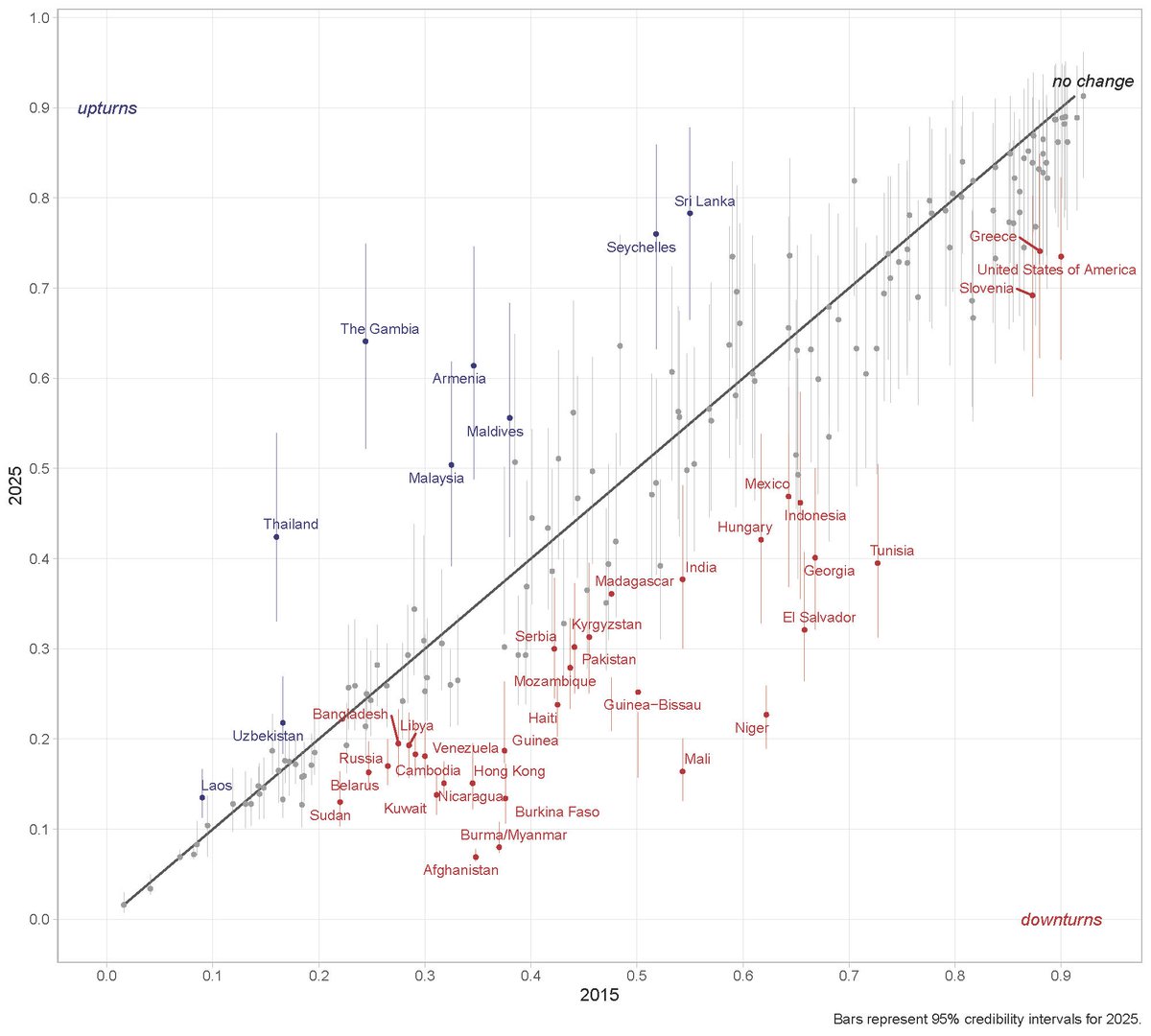
Figure 1: Comparison of scores in 2015 and 2025 for V-Dem’s Electoral Democracy index. Significant upturns in blue, and significant downturns in red. Countries below the diagonal line have lower scores in 2025 than 2015; countries above the diagonal have higher scores. Vertical lines represent uncertainty (95% credibility intervals) for 2025 scores.
If we zoom in on the past year, our indices suggest that the level of democracy has remained relatively stable in the vast majority of countries.
However, several countries including Mauritius, South Korea, and Sri Lanka experienced significant improvement. Others, including Georgia and Moldova, experienced marked deterioration.
Comments on the data for the United States
The country where we observe the most deterioration from 2024 to 2025 is the United States. On V-Dem’s Liberal Democracy index the United Stated dropped by a total of 0.18. This reduction is about three times larger than the country experiencing the second-largest drop over the year. More specifically, the United States scored 0.75 on V-Dem’s Liberal Democracy index in 2024 and 0.57 in 2025. In 2025, the United States was ranked 51st among 179 countries on the Liberal Democracy index.
The United States’ scores for V-Dem’s Electoral Democracy index in 2024 and 2025 were, respectively, 0.84 and 0.74. While relatively smaller than the decline on the Liberal Democracy index, the United States was also the country that declined the most on the Electoral Democracy index. The second-largest drop (0.08) from 2024 to 2025 was registered in Georgia. In 2025, the United States was ranked 46th among 179 countries on the Electoral Democracy index. The level of democracy in the United States, according to these two measures, was in the range of its historical scores in the 1960s and 70s.
We highlight that V-Dem’s indices are measured with uncertainty. The numbers above represent our best estimates. To be more specific on the uncertainty, V-Dem’s low and high estimates (based on so-called 68% credibility intervals) for the United States on the Liberal Democracy index in 2025 are, respectively, 0.51 and 0.62. The equivalent numbers for the Electoral Democracy index are 0.69 and 0.79.
Nonetheless, the changes recorded in the United States from 2025 to 2024 are considerable one-year drops (in the following, the numbers we refer to are V-Dem’s best estimates). They are, by far, the largest drops in United States history going back to 1789. To place these numbers in a global context: If we consider all 25,464 country-year observations that have data on V-Dem’s Liberal Democracy index from the year 1789 to 2025, only 36 (0.14 percent) of these observations have experienced a larger one-year drop than the United States from 2024 to 2025. The largest drop for a single year (0.49) was recorded in the Netherlands in 1940.
The drop on the Electoral Democracy index was notably smaller, though still sizeable; only 163 (0.64%) of the observations in the V-Dem dataset have registered larger decreases on this index in a single year.
Please note that election-specific indicators (such as the extent of election fraud in the last election) are, quite naturally, not evaluated each year, but only in election years. This means that the 2025 scores for the United States on all election-specific indicators are based on the characteristics of the 2024 elections. Since election-specific indicators figure quite heavily in V-Dem’s Electoral Democracy index, there is a limit to how much a country such as the United States can drop on this index from 2024 to 2025.
The indicators contained in the Liberal Democracy index where the United States displays the largest drops from 2024 to 2025 pertain mainly to constraints on the executive, rule of law and individual liberties, or to freedom of expression and the media environment. Specific examples are indicators on executive oversight by other bodies than the legislature, the legislature investigating unconstitutional, illegal, or unethical activity by the executive in practice, government censorship effort over the media, and freedom of academic and cultural expression. Indicators pertaining to the freedom of association, suffrage, or the execution of elections experienced far less or no change between 2024 and 2025.
Read more about the different concepts of democracy used by V-Dem and the indices that represent each concept in our FAQ