Increased Polarization in Germany
By: Lavinia Klarhoefer
Sep 30, 2024
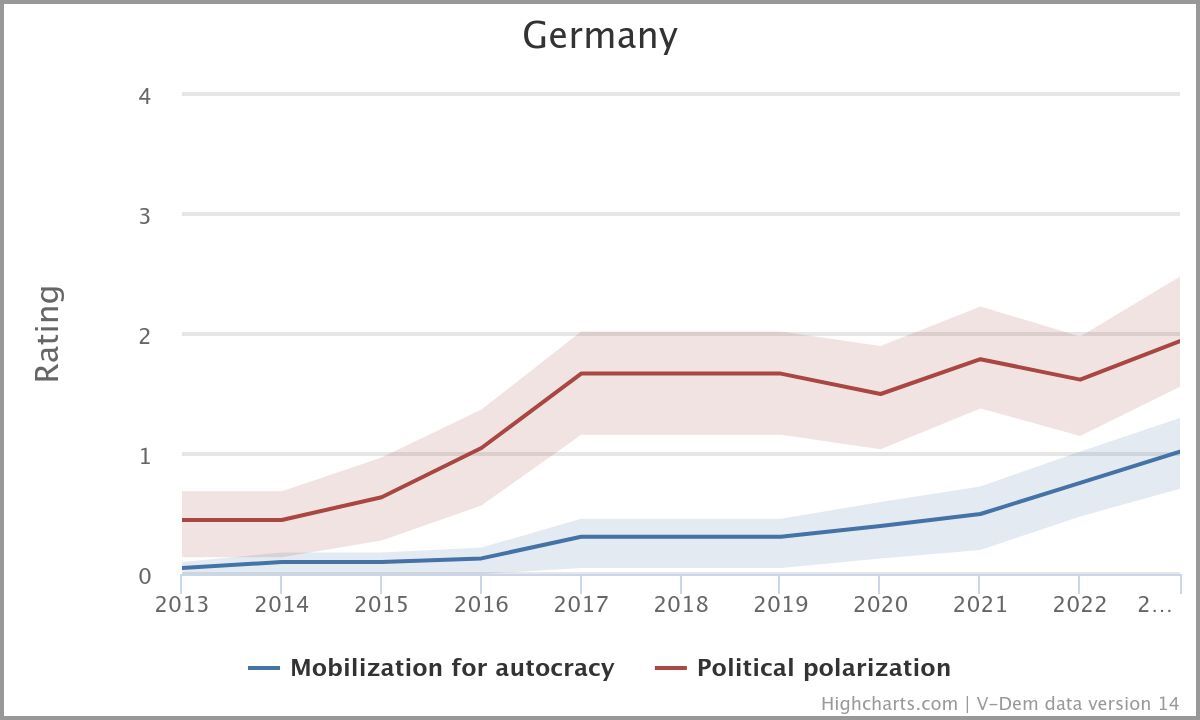
The recent German elections in three eastern states saw the first electoral victory of the far-right since the Second World War, with the Alternative for Germany (AfD) win in the state Thuringia. This week’s graph shows how mobilization for autocracy and political polarization have increased in Germany since the far-right party AfD was founded in 2013.
In this year’s state elections, AfD came close to victory in Saxony and Brandenburg, with over 30% and 29% of the votes respectively, and winning in Thuringia with almost 33% of the votes.
The party has been rising in popularity, entering the national parliament Bundestag in 2017 with 13% of votes and has maintained a similar level of support in federal and European elections. However, the party’s stronghold lies in the eastern states of Germany.
Gaining momentum during the 2015 refugee crisis, the party has polarized society around a strong anti-immigration stance and is being investigated by federal intelligence for right wing extremism. The V-Dem indicator ‘mobilization for autocracy’ is capturing aspects of this.
International media has expressed concerns that the state elections indicate a shift to extremes: along with the far-right advances, the state elections also saw a strong far left, thus reinforcing the increasing polarization, as captured in the graph below.