Political Party Hate Speech in the 21st Century
By: Timna Besenbäck
Dec 16, 2025
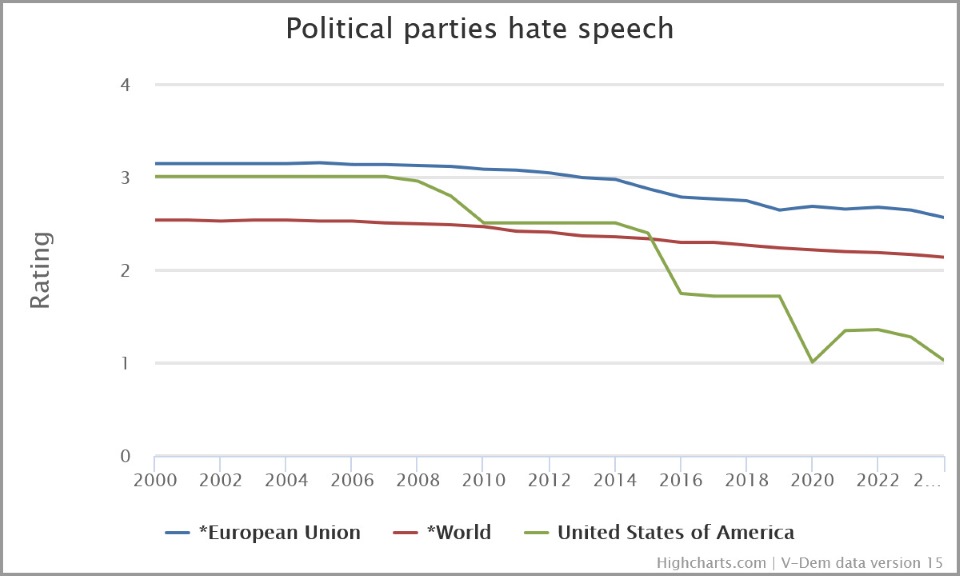
The use of hate speech as a political party technique has increased since the turn of the millennium. This week’s graph shows how often major political parties use hate speech as part of their rhetoric on a scale from 0 (extremely often) to 4 (never, or almost never) over the past 25 years. Note that the scale of the graph is reversed, meaning that the more hate speech, the lower the score.
In the beginning of the 21st century political party hate speech was almost equally rare in the U.S. as in the EU, with both performing better than the world average. However, this pattern started to change in 2009. Around the same time, the Tea Party movement emerged as a reaction to Barack Obama's first presidential term and the financial crisis. Since the movement used violent rhetoric and had the support of Republican politicians, a connection to the increase in political party hate speech may be drawn.
Following this first initial increase in hate speech rhetoric, an even stronger increase appeared in 2016 – the year Donald Trump was first elected. Since then, political party hate speech has been worse in the U.S. compared to the world average.
Another sharp increase appeared in 2020, the year Trump ran for re-election. In general, the 2020 U.S. election created an environment that amplified hate comments and brought online hate communities closer together.
Although Donald Trump had been known for his violent rhetoric since his first election campaign, by 2024 hate speech had become normalized, and objections from his own party had largely disappeared.
While the trend is not as dramatic as in the U.S., the gradual increase in hate speech within the EU should not be neglected. Hate speech is a major threat to democracy as it divides societies, undermines plurality, and limits participation of targeted groups and individuals.
Additionally, hate speech is a slippery slope to hate crimes, which in turn generates fear and distrust within societies and limits civil liberties through self-censorship. In that sense, hate speech harms others’ freedoms of expression, association, and assembly. Thus, tolerating hate speech does not defend liberal democracies but undermines them.